
The IRS has officially released the 2027 401(k) contribution limits, giving employees the opportunity to save even more for retirement next year. For employers, these annual changes come with a few important action items. From updating payroll settings and retirement plan documents to communicating the new 401(k) limits and preparing for Roth catch-up contribution requirements for higher-income employees, now is the time to make sure your payroll and benefits processes are ready for 2027.
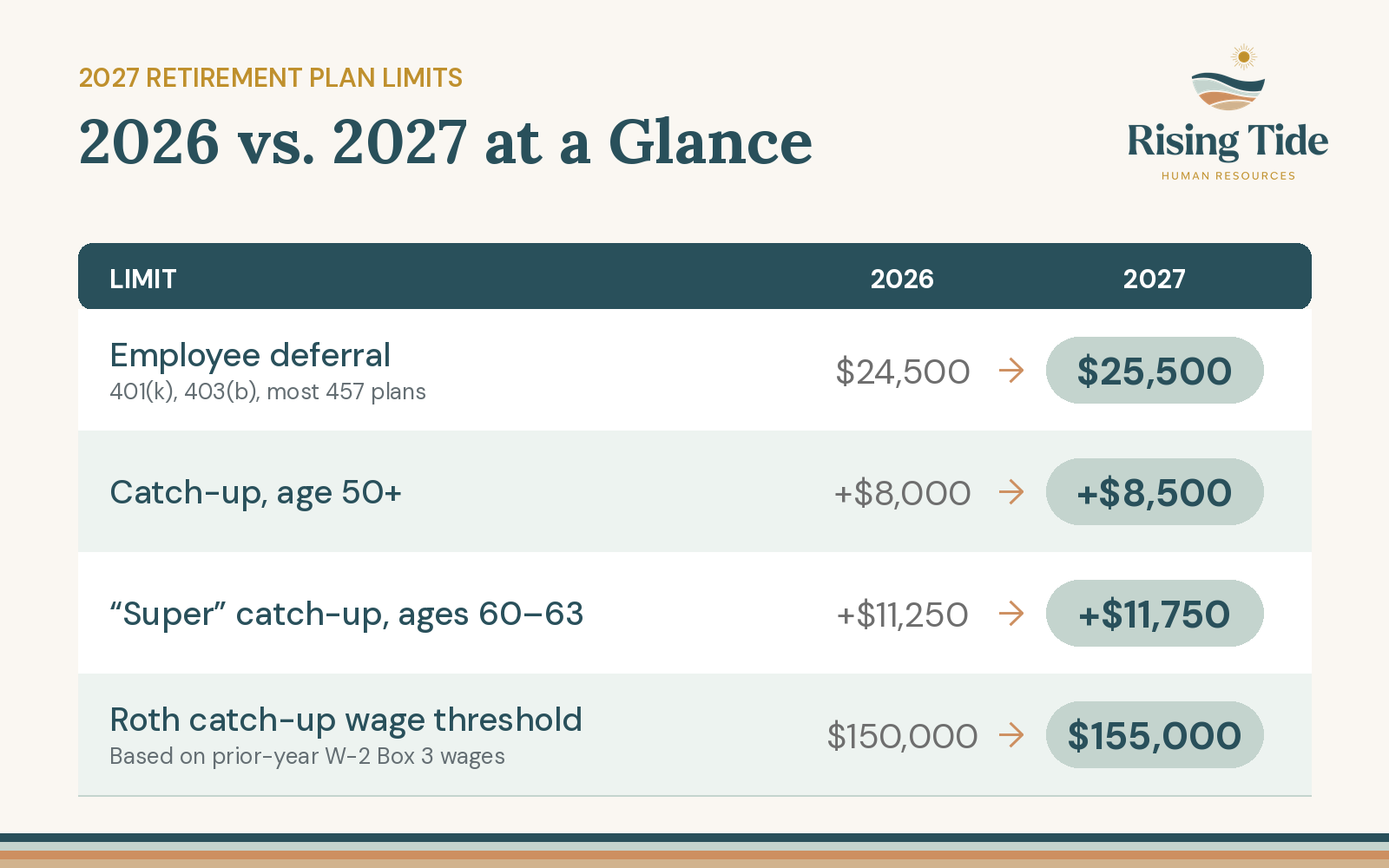
What that means in practice: in 2027, an employee age 50 or older can defer up to $34,000 ($25,500 + $8,500). An employee who turns 60, 61, 62, or 63 during 2027 can defer up to $37,250 ($25,500 + $11,750). The higher age 60–63 catch-up replaces the standard catch-up for those years; it doesn't stack on top of it.
A Quick Reminder About Roth Catch-Up Contributions for High Earners
Starting in 2026, employees age 50 and older who earned more than the IRS wage threshold in the prior year are required to make their catch-up 401(k) contributions as Roth (after-tax) contributions rather than pre-tax.
For 2027, that threshold increases to $155,000, based on the employee's 2026 Social Security wages (W-2 Box 3) from your company. Here are a few things employers should keep in mind:
It's based on the prior year's W-2. An employee's 2026 Box 3 wages determine whether the Roth catch-up requirement applies in 2027. Employees who are new to your company and don't have prior-year wages from you generally won't be subject to the requirement yet.
Your retirement plan must offer a Roth option. If your plan doesn't allow Roth contributions, employees subject to this rule won't be able to make catch-up contributions. If you have employees approaching or over age 50, now is a good time to confirm this option is available.
It only applies to catch-up contributions. Employees can still make their regular deferrals (up to $25,500 in 2027) on a pre-tax basis. Only the additional catch-up contributions must be made as Roth contributions.
Now is the time to check in with your payroll provider and 401(k) administrator. Make sure they have a process for identifying affected employees, applying the Roth requirement correctly, and handling catch-up contributions throughout the year. Don't wait until January to find out your systems aren't set up to handle it!
Year-End Retirement Plan Checklist
A little preparation now can save a lot of payroll headaches in January. Here are four things to get on your checklist before the first 2027 payroll:
1. Update your payroll limits. Make sure your 2027 401(k) deferral and catch-up contribution limits are updated before your first January payroll.
2. Identify employees eligible for catch-up contributions. Review employees age 50+ and those turning 60–63 during 2027 to ensure the correct catch-up limits are applied.
3. Review your high-earner wages. Run a 2026 W-2 Box 3 wage report to identify employees who earned more than $155,000 and will be subject to the Roth catch-up requirement in 2027.
4. Confirm your systems are ready and communicate the changes. Make sure your retirement plan offers a Roth option and your payroll provider and 401(k) recordkeeper are aligned. Then send employees a quick reminder about the new limits so those who regularly max out their contributions have time to adjust their per-paycheck elections.
Retirement plan rules change every year, and the details live where payroll, HR, and accounting overlap. Rising Tide HR helps small and growing businesses keep payroll settings accurate, communicate benefits clearly, and stay compliant as the rules shift. If you'd like a second set of eyes on your 2027 setup, reach out to our team. We're happy to help.
This post is for general informational purposes and isn't tax, financial, business, or legal advice. Please check with your plan administrator or tax advisor about your specific plan details.
